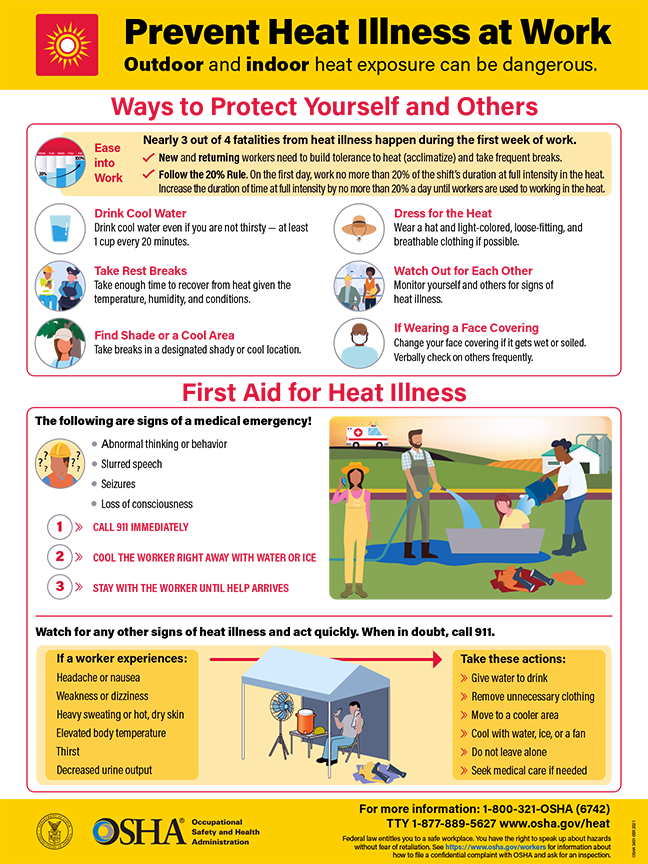
There is no overall federal safety regulation for work heat safety, but OSHA just extended its National Emphasis Program till 2031.
Obviously, summer in Illinois and Indiana is not renown for the staggering high temperatures workers face in other parts of the country, though we do get the periodic heat wave. For instance, outdoor workers in Phoenix have to contend with afternoon temperatures reaching 115 degrees this week.
Nevertheless, heat is a serious injury risk on a surprising number of our local worksites, both outdoor and indoor. People need to be alert to the danger of being hurt by illness or accident caused by bodily exposure to heat.
It is a serious threat: significant heat-related hazards are recognized by the Occupational Health and Safety Administration (“OSHA”) in many of our local industrial worksites where people can suffer debilitating illnesses or catastrophic injuries in a work accident involving high heat exposure. For more, see Stevens, Hannah. “Facing the Heat Alone: How the Absence of an Imminent National Heat Prevention Standard Puts Workers at Risk.” California Western Law Review 60.3 (2024): 7.
Heat Injury on the Job: OSHA Extends Its National Emphasis Program
This spring (April 2026), OSHA updated its National Emphasis Program for Outdoor and Indoor Heat-Related Hazards (“NEP”), making it effective through 2031, where it will “…direct agency resources where they can make the biggest impact—focusing inspections and outreach in industries and workplaces where heat stress risks are most likely to occur,” and expanding its list of “high hazard” industries for heat injury risks from 33 to 55 recognized worksites where heat can endanger workers.
OSHA is pointing the finger at specific workplaces where its research and past experience confirms that workers face a great risk of being hurt on the job because of high heat in their work environment.
The updated OSHA Worksite Heat Danger List includes a wide range of industrial sites that are common to Illinois and Indiana, including:
- Non-construction industries like Ranching and Farming; Animal Slaughtering and Processing; Various Food Manufacturing Plants; Steel Product Manufacturing; Petroleum and Coal Products Manufacturing; Plastic, Cement, or Concrete Product Factories; Nonferrous Metal (except Aluminum) Production and Processing; Foundries; Metalworking; Motor Vehicle Body and Trailer Manufacturing; Machinery, Equipment, and Supplies Merchant Wholesalers; Grocery Product Merchant Wholesalers; General Freight Trucking; Transportation Support (Air; Rail; Water; Road); Warehousing and Storage; Delivery Services; Landscaping; Waste Collection; and Automotive Repair and Maintenance.
- Construction worksites including Residential; Nonresidential; Utility System Work; Road Construction (Highway, Street, Bridge); Foundation, Structure, and Building Exterior Contractors; Building Equipment and Finishing Contractors; and Other Specialty Trade Contractors.
From OSHA, in its press release announcing the continuation of its National Emphasis Program:
Heat illness remains a serious hazard for indoor and outdoor workers, leading to preventable injuries and fatalities every year. Ensuring that employers take the steps needed to safeguard workers is essential, and this updated program allows OSHA to better focus on outreach, compliance assistance, and enforcement efforts in high-risk industries and promote effective prevention practices.
OSHA’s Program to Protect Against Heat Dangers on the Job in Illinois and Indiana
The OSHA NEP regarding heat risks does apply to worksites in Illinois and Indiana, even though workers may know that both Illinois and Indiana operate “state-run plans”. For more, read Important Things to Know About OSHA Protections and Work Accidents in Illinois or Indiana; and Workplace Safety and OSHA Regulations in Indiana and Illinois.
Illinois provides guidance for its employers on how to keep workers safe on the job, addressing the OSHA NEP concerns with advice like (1) training for workers and supervisors; (2) monitoring workplace conditions; (3) conducting heat assessments; (4) implementing hazard controls; and (5) preparing for medical emergencies. Read, OSHA’s 5-Step Heat Plan Explained, published by the Department of Labor for the State of Illinois’ OnSite Safety and Health Consultation Program (“Worksafe”).
Likewise, the Hoosier State’s Department of Labor references employers to study employer responsibilities provided online by OSHA’s Overview: Working in Outdoor and Indoor Heat Environments while publishing detailed information for employees to help them keep safe from harm caused by high heat in their particular work environment, also as provided by Federal OSHA.
Worker Dangers from Exposure to High Heat: Illness and Injury
People can suffer serious illness or even die from exposure to high temperatures on the job. Heat illness dangers are a disturbing reality for of our many worksites, from commercial bakeries to boiler rooms to steel mills to warehouses, not to mention outdoor work like construction or landscaping. Accidents can also happen because of workers endangered by heat in their jobsite, where bodily injuries can result in permanent harm (like amputation) or a fatal injury.
1. Heat-Related Illness on the Job
Internal body temperatures, if unable to dissipate properly, can result in stroke, cardiac arrest, or death. Workers may suddenly collapse, faint, become disoriented, or lose consciousness on the job simply because of unacceptable and unsafe levels of heat exposure. For details, read OSHA’s Working in the Heat: Know the Hazards (OSHA 4401-02 2024). Also see: Monahan, Kate, and Andrea Ranger. “RISING TEMPERATURES, RISING RISKS.” (2026).
2. Accident Injuries Caused by High Heat Work Environment
Working in high temperatures may be a part of the worker’s day here in Illinois and Indiana, whether the job is on a road construction site (think Project Rebuild Illinois) or in a local steel mill (like the famous Gary Works in Gary, Indiana).
However, serious or deadly work injuries are known to be tied to these high heat environments, where the job comes with risks of things like slip and falls; struck-by accidents; crushing injuries; or blunt force trauma caused by a power or hand tool. The heat itself can cause the worker’s body to react more slowly, or to have less stability or balance. The worker suffering in heat may not be able to concentrate or focus or make judgments as clearly because of the body’s exposure to the high temperatures. For more, read Alahmad, Barrak, et al. “A nationwide analysis of heat and workplace injuries in the United States.” Environmental Health 24.1 (2025): 65.
Liability for Illness or Injury Caused by High Heat at the Workplace
Currently, there is no specific federal regulation regarding high heat work environments. See, “Indiana’s 8th district fights over OSHA workplace heat rule,” written by Ian Young and published by Fox59 News on July 29, 2026. This does not mean there is no duty of care placed upon employers here in Illinois and Indiana to protect workers from being hurt on the job from high heat exposure.
Employers, and others with possession, custody, or control of aspects of the jobsite are still mandated by law to keep workers safe from harm in high temperatures by the General Duty Clause of the Occupational Safety and Health Act. Read, What is the Employer’s General Duty Clause?
Here, OSHA may use the General Duty Clause to find regulatory violations if it can be shown that there was a heat hazard; the heat hazard was recognized by the industry or by that entity; that the heat hazard caused or was likely to cause death or serious bodily harm; and that there was a reasonable way to materially reduce the heat danger and this was not done.
For worker victims hurt by heat illness or an accident caused by high heat conditions, the violation of the General Duty Clause will work as part of their claim based upon state laws of negligence, product liability, premises liability, and other personal injury causes of action. The disregard of the High Heat protections and protocols of the current OSHA NEP can be very important in establishing legal liability for one or more parties and individuals involved in that worker’s particular circumstances.
To learn more about work accident injury claims in various industries with high heat dangers, see:
- Top Five Construction Workers Facing Greatest Risk of Summer Heat Death
- The Dangers of Heat Exposure for Ironworkers in Cook County, Illinois
- Hot Workplace: Injuries or Death from Heat Exposure in Indoor Work Environments
- Extreme Heat on the Job: Danger of Severe Worker Injuries or Death
- Industrial Standards, OSHA Regulations, and Work Accident Injury Claims.
High temperatures on the job come with specific risks that all those with power, custody, or control of any part of the worksite should understand and respect. Construction workers, steelworkers, anyone on the job in one of our busy manufacturing plants, all have a right to expect protection for high heat related harm.
Sadly, the risks of heat exposure illness or injury remains so high that OSHA has continued its National Emphasis Program for another five years. Please be careful out there!